Most players who bother to review their games make the same mistake: they jump straight to the biggest blunder, nod at the engine's answer, and close the analysis. That's not learning — it's slightly more dignified than not analyzing at all, but the outcome is roughly the same. They'll be back in the same position next week, making the same kind of error, wondering why their rating doesn't move.
Why Most Game Analysis Goes Nowhere
The problem isn't effort. Players do sit down to review their games. The problem is the question they're trying to answer. Most game review is really just "where did I lose material or miss a win?" — useful in isolation, but the wrong starting point.
When you open the engine and look only at the red squares, you're diagnosing symptoms, not causes. You see that you played Nxd5 when Bd3 was better. You note it and move on. But you haven't asked the question that would actually help: what were you thinking when you played that, and what decision pattern led you there? A blunder doesn't appear out of nowhere. It comes from a specific sequence of decisions in the minutes before it. Skipping that part means you have the correct answer but not the understanding that would help you find it next time.
The engine tells you the output was wrong. What you need to understand is why the process that produced it was flawed. Reviewing blunders without that context is like memorizing the wrong symptoms — you know something went wrong, but you can't prevent it happening again.
What You're Actually Looking For
Here's the reframe that makes analysis useful: you're not trying to find the best move in each position. You're trying to find the moment your thinking went wrong.
There's a meaningful distinction between a move being a blunder and a decision being a mistake. Sometimes a blunder is just miscalculation — you saw the right idea but calculated wrong. That's a different problem than choosing the wrong plan entirely, or missing your opponent's threat because you weren't looking for it. The engine can't tell you which one it was. Only you can.
What you want to locate are the "critical moments" in a game — positions where the game changed direction. A moment where your opponent had a key idea you didn't see coming. A decision point where you chose passivity over activity. A position where you felt something was wrong but talked yourself out of it. These are the positions worth spending time on. Not every move with a slight evaluation shift — those are noise at the club level. The moments that decided the game.
Usually there are two or three of them per game. Finding those moments, understanding what happened in your thinking at each one, and extracting the pattern behind the error — that's the whole process. If you want to go deeper on how to actually learn from chess mistakes rather than just find them, that article covers the four-question framework in detail.
The Step-by-Step Analysis Method
The following five-step process works for any game at any level. Each step builds on the previous one. Skipping straight to Step 4 — the one most players start with — is exactly the habit this method is designed to break.
Step 1 — Play through the game once without an engine
Replay the game from the start with the board, no engine. Don't evaluate every move. Don't second-guess decisions. Just watch it unfold and pay attention to how it felt at the time. Note where you felt confident, where you felt uncertain, and where something surprised you — either because you found something better than expected, or because something went wrong you didn't see coming.
This first pass reactivates your memory of your own thinking. The faster you do it after a game, the better. Analyze within 24 hours where possible. After a week, you've largely forgotten what you were thinking on move 17. After a month, you're reconstructing a narrative about the game that may have little to do with what actually happened in your head.
A practical habit: play through the full game before dinner after a session. The 15 minutes while food is heating is enough for a useful first pass.
Step 2 — Mark the moments that felt wrong or uncertain
On your second pass, stop at every position where you remember feeling uneasy, uncertain, or where something surprised you. Mark these positions — on paper, in your analysis software, or just mentally. Don't skip one because the engine later confirms your move was fine. If you felt uneasy, there was a reason — you may have been right about the position but wrong about why, or you were lucky your opponent didn't find the refutation.
For example: you played Nf6 but hesitated for two minutes before doing it. The engine says it was fine. But why did you hesitate? Was there a threat you half-saw and dismissed? Mark it anyway. The hesitation is information about your thinking, and that information is valuable even when the move turned out to be correct.
Also mark positions where the momentum of the game shifted — where a piece suddenly became dominant, where the position simplified in a way you didn't control, or where your opponent played something you hadn't considered at all.
Step 3 — Try to find the improvement yourself before checking the engine
For each marked position, sit with it and try to find what you missed before opening the engine. What should you have played? What idea weren't you considering? What was your opponent threatening that you didn't calculate through?
This is the hardest step for most players, because the engine is one click away and the answer is instant. Resist it. This is where the actual learning happens. If you can find the correct idea yourself — or get close — you've processed it at a level that sticks. If the engine reveals something you'd never have found, you at least know the specific gap you're working with: you weren't calculating that type of combination, or you were ignoring that structural feature entirely.
Even three minutes per position doing your own work before checking is meaningful. "The engine suggests Bxh6 — I wonder why" is a fundamentally different mental state from "oh, Bxh6 was better, noted, next."
Step 4 — When you check the engine, ask "why" not just "what"
Most players use the engine as an answer machine: what was the best move? What you need to use it as is a question machine: why was my move worse? What did my move fail to accomplish? What threat does the engine's suggestion create that mine ignored?
Don't just accept the evaluation shift. Sit with the engine's top choice and try to understand the idea. What does it enable on the next two or three moves? If you're using a tool that provides plain-language explanations alongside the engine lines — like an AI chess coaching report — those explanations are often more useful than the raw lines, because they name the pattern, not just the move.
One practical habit: for each significant error, write out in words (not chess notation) why the engine's move was better than yours. "Because it kept the bishop active and avoided the trade that led to a passive rook ending" encodes real understanding. "Bb5 +1.2" encodes nothing.
Step 5 — Write down one pattern to watch for in your next game
Every analysis session should end with a single written lesson. Not "play better tactically." Something specific and actionable: "Before initiating any piece trade in the endgame, check whether my king has enough activity to compensate." Or: "When my opponent plays a quiet move, stop and ask what it's preparing before responding with my own plan."
This lesson should be short enough to read in 30 seconds. Read it before your next game. The goal is to bring it into your conscious thinking while you play, before it disappears into autopilot. After 20 games, look back at your written lessons. You'll start to see the same patterns appearing repeatedly. That repetition is your most important training signal.
The Mistake Most Players Make With Engine Analysis
The most common misuse of engine analysis is treating Stockfish as the authority on "what you should have played" rather than as a tool for understanding why your own thinking was flawed. The engine gives you the best output. It can't tell you anything about the process that produced your output.
Stockfish says Bxh6 was winning. Fine. But it doesn't tell you whether you missed it because you weren't calculating forcing lines at all, or because you calculated to Bxh6 and dismissed it based on a faulty evaluation of the resulting endgame, or because you saw the idea but weren't confident enough to execute it. Each of those is a different problem requiring a different fix. The engine doesn't distinguish between them.
This is where most game review stays permanently shallow: the engine shows the correct answer, the player accepts it, nothing changes. If you find yourself repeating the same types of errors despite regular analysis sessions, this is almost certainly the reason. You've been collecting correct answers, not building understanding.
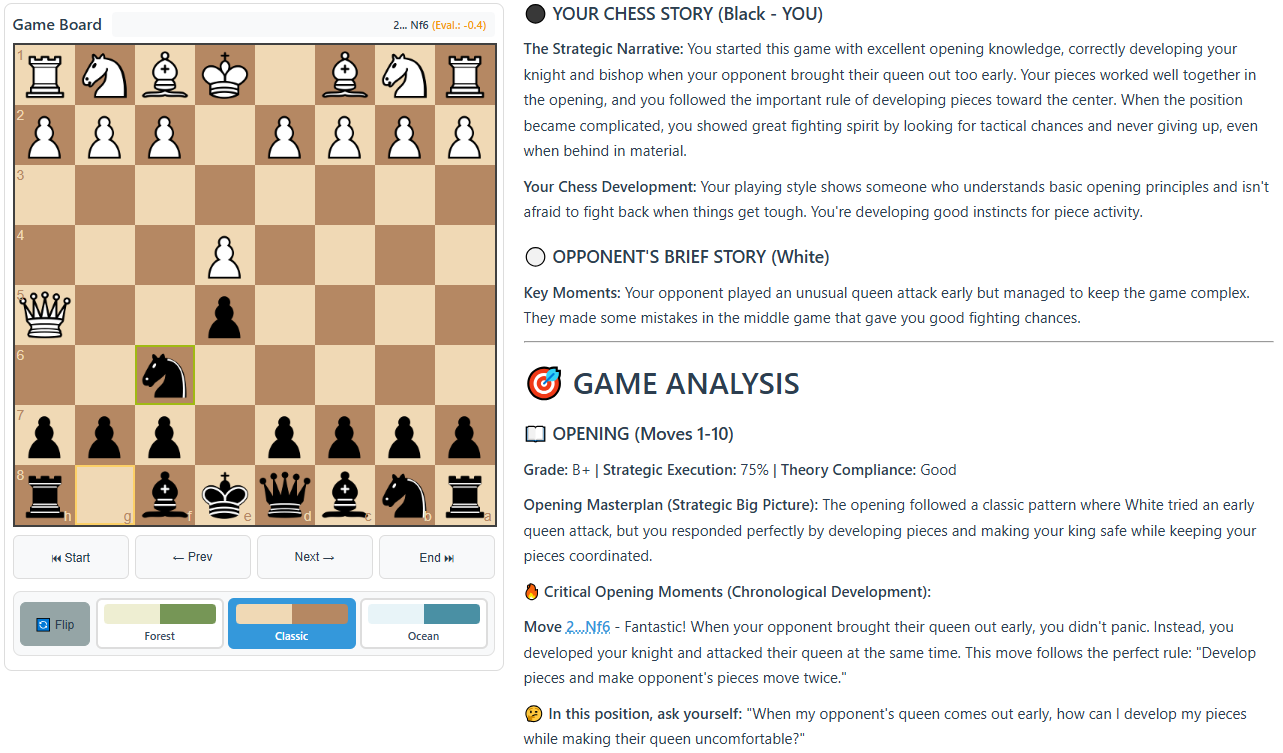
Tools like AICoachess are designed to close this gap. An AI chess coaching report doesn't just show that Bxh6 was winning — it explains the pattern behind the combination, what your actual move was trying to accomplish, and why the thinking that produced it broke down at that moment. That's the difference between a correction and an explanation. Only explanations change your play at the board.
Use the engine to verify and discover. Use the coaching layer to understand. That combination is more useful than either tool alone — and it's far more useful than an engine alone, which is what most players are working with.
How Often Should You Analyze Your Games?
Quality matters far more than quantity. One game analyzed properly per week — really sitting with the critical moments, doing your own work before checking the engine, writing down a concrete lesson — is worth more than skimming five games in the same time. The habit of skimming is actually worse than no analysis, because it creates the feeling of having done the work without the benefit.
A proper analysis session, done well, takes 30 to 45 minutes for a typical game. That's Step 1 (5-10 minutes), Step 2 (5 minutes), Steps 3-4 across two or three key positions (10-15 minutes), and Step 5 (5 minutes). If time is short, focus on Steps 2 and 5 at minimum: mark the critical positions and write the lesson. Even 15 minutes of focused analysis beats an hour of clicking through engine variations.
Prioritize losses. If you only have time to analyze some of your games, start with the ones you lost. Wins are worth reviewing too — especially when you won by luck or your opponent missed something obvious — but losses have the highest density of diagnostic information. The game where you were completely in control from move 1 to move 40 doesn't teach you much. The loss where you were slightly better and then made a strategic error in the endgame teaches you exactly where your thinking breaks down under pressure.
A Note on Using AI Analysis Tools
For most of chess history, getting coaching-quality explanations of your mistakes required paying for a human coach. The engine could find the errors. Only a coach could explain them. That was a real bottleneck for club players — one that had nothing to do with how hard they were willing to work.
AI analysis tools have changed what's possible. A personalized chess coaching report can now provide game-level explanations at scale: why your thinking led you to a particular move, what pattern was missing, what to work on as a result. For players in the 800-1600 range, this kind of specific, game-level feedback is exactly what self-improvement has been missing.
That said, AI tools work best as a complement to your own thinking — not a replacement for it. The five-step method above still matters. Going through the game yourself, marking the critical moments, and trying to find improvements before checking — that's where the mental habits are built. AI analysis is most valuable when you've already done your own work and want to check it, deepen it, or catch what you missed. If you skip straight to the coaching report without doing Steps 1-3 yourself, you lose the most important part of the process.
The combination — self-analysis first, AI coaching report second — is more powerful than either alone. The full explanation of what chess engine analysis gets wrong covers this in depth if you want to understand how to get the most out of any analysis tool.
Improvement in chess doesn't come from knowing that a different move was better. It comes from understanding what in your thinking produced the move you actually played — and changing that pattern at its root. The method above is the mechanism. The discipline to use it consistently, game after game, is what separates players who improve from players who stay stuck at the same rating for years.
See What a Proper Game Analysis Looks Like
AICoachess generates a full coaching report for any game — explaining what went wrong, why, and what to work on next. From €1 per game.
Analyze My Game